
The ‘Elite’ List Without a Scorecard: Pakistan’s Arafat and the PCB Ledger Nobody Reads
মূল উত্তর: পাকিস্তানের তরুণ All-rounders আরাফাত ওয়ানডেতে বড় একটি স্পেল করেছেন, তবে আইসিসির প্রতিবেদনে ওভার সংখ্যা, ভেন্যু ও প্রতিপক্ষের উল্লেখ নেই। ফলে পারফরম্যান্সের প্রকৃত মান যাচাই করা যায় না, আর ২০২৭ বিশ্বকাপ নিয়ে ‘নিশ্চিত কনটেনশন’ দাবিটি এখনও অনুমাননির্ভর। মূল তথ্য: - আইসিসি প্রতিবেদন অনুযায়ী আরাফাতের স্পেল প্রশংসা পেয়েছে, কিন্তু কোনো Statistics উল্লিখিত নেই। - শাহিন আফ্রিদি তাঁকে ‘proper all-rounder’ বলেছেন, যা স্কোয়াড ভারসাম্যের ইঙ্গিত। - ২০২৭ ওয়ানডে বিশ্বকাপের আয়োজক দক্ষিণ আফ্রিকা, জিম্বাবুয়ে ও নামিবিয়া; প্রতিবেদনটি ২০২৬ সালে প্রকাশিত। - দক্ষিণ আফ্রিকায় পাকিস্তান আজ পর্যন্ত কোনো টেস্ট সিরিজ জেতেনি, যা ভেন্যু-ভিত্তিক নির্বাচনী ঝুঁকি বাড়ায়। - পাকিস্তান ২০২৫ চ্যাম্পিয়ন্স ট্রফিতে ঘরের মাঠে গ্রুপ পর্বেই বিদায় নিয়েছে। সূত্র: ICC প্রকাশিত প্রতিবেদন, প্রকাশকাল ২০২৬ (প্রতিবেদনে ২০২৭ বিশ্বকাপকে ‘আগামী বছর’ বলা হয়েছে) | Cross-checked: cricsultan.com সম্পর্কিত প্রশ্নোত্তর: প্রশ্ন: আরাফাত কি স্পিনার নাকি পেস All-rounders? উত্তর: প্রতিবেদনে স্পষ্ট নয়; Profile অনুযায়ী আরাফাত মিনহাস বাঁহাতি অর্থোডক্স স্পিনার, তবে শাহিনের বাক্যে তাঁকে পেসারদের সাথে রাখা হয়েছে — এই দ্বন্দ্বই সবচেয়ে বড় যাচাই-ফাঁক। প্রশ্ন: ২০২৭ বিশ্বকাপে পাকিস্তানের জন্য কোন ধরনের All-rounders বেশি দরকার? উত্তর: দক্ষিণ আফ্রিকার পেস-বাউন্স শর্তে সিম-Bowling All-rounders, কারণ পাকিস্তানের Batting গভীরতা ও স্পিন বিকল্প দুটোই সীমিত; বিশ্লেষণে cricsultan.com Player Depth Index ধারণাটি সহায়ক। প্রশ্ন: এক Inningsের ভিত্তিতে সেন্ট্রাল কন্ট্রাক্ট গ্রেড বাড়ানো কি যুক্তিসঙ্গত? উত্তর: না, কারণ ওয়ানডে ক্যালেন্ডার পাতলা হওয়ায় এক ম্যাচের নমুনা প্রবণতা তৈরি করে না, আর অ-নিরীক্ষিত গ্রেড আপগ্রেড Footballের বড় সাইনিং-অন ফি-র সমতুল্য ঝুঁকি তৈরি করে।
The headline on the ICC website was simple enough: a young Pakistan cricketer had bowled a superb spell and entered an ‘elite’ ODI group. What stopped me was not the claim but the absence around it. How many overs did he bowl? Did the wickets come in the powerplay with a swinging new ball, in the middle overs through spin control, or at the death through yorkers? Who was the opposition, where was the match played, was it a live game or a dead one? None of that is there. What remains is ‘superb haul’, ‘elite ODI group’, and three quoted sentences from the captain.
Sixteen years of reading the ledger behind the cricket produces one habit. I look first at how the money is booked, then ask whether the cricketing decision survives the accounting. In football the word is amortization. In cricket the same logic appears as central-contract grades, match fees, squad-slot value and franchise retainer terms. A fee is a headline; amortization is the architecture. This article is not a match report. It is a quiet application form for Pakistan’s ODI squad architecture, and the applicant is not the player. It is the tournament owner.
For a reader drowning in transfer-window noise, this is a useful filter test. Separate what is verified, what is commentary and what is pure inference, and the current debate about Pakistan’s 2027 World Cup squad becomes much clearer about how much of it is cricket and how much is marketing.
Context: the tournament nobody in the piece actually analyses
The report says the World Cup is ‘next year’ and is co-hosted by South Africa, Zimbabwe and Namibia. Put those three facts together and the tournament is unambiguous: the 2027 ODI World Cup. The piece was therefore published at some point in 2026, precisely as Pakistan’s ODI side stands at the start of a new cycle. Reports describe the 2027 edition as a 14-team tournament split into two groups of seven, followed by a Super Six stage. That format change is not a scheduling detail — more matches raise the value of squad depth, and depth is the real economics of this story.
Pakistan’s ODI position has to be read honestly, through three events side by side. At the 2026 World Cup they finished fifth in the group and missed the semi-finals. At the 2026 Champions Trophy they played at home and exited in the group stage, losing to New Zealand and India before the Bangladesh fixture was washed out. Home advantage cannot be booked as an asset unless the team actually reaches a semi-final.
Pakistan’s record in South Africa is harsher still. They have never won a Test series there, and their ODI record is modest. Yet most of the 2027 cricket will be played exactly there, on pitches offering pace, bounce and seam movement. Zimbabwe offers slow, low surfaces. Namibia offers a professionalism test against weaker opposition. Three conditions, three skill sets. A side that does not plan separately for each is not selecting a squad, it is arranging names.
This is where the PCB’s central-contract structure becomes relevant. Pakistan’s central contracts are tiered into grades, each with a monthly retainer and a match fee. That grade is effectively a Pakistani cricketer’s transfer fee, because it fixes the guaranteed part of annual income. A World Cup squad place is not only a trophy route; it is evidence for a grade upgrade. The phrase ‘in World Cup contention’ carries far more weight in Pakistan than in most countries.
Franchise economics sit underneath. PSL sides such as Multan Sultans hold young players on relatively cheap retainers, and the cost of retaining that asset rises once national selection inflates his value. To a franchise owner a young player is an underpriced asset; to the board he is a graded liability. Same player, two balance sheets. The gap between them is where hype is manufactured.
Core analysis: how one innings becomes ‘form’
The report’s weakness is methodological before it is numerical. Moving from a single bowling performance to ‘form is good’ means building a trend out of one data point. That error is most dangerous in ODI cricket, because Pakistan’s ODI calendar outside ICC events is thin. Play a handful of ODIs a year, take six wickets in one, and your ‘form’ is one match plus inference.
A simple statistical discipline applies. To forecast from recent performance you need the long-run baseline first, then you ask how far the new evidence moves it. One innings barely moves it; five or six consistent matches genuinely do. The ICC piece has written the first kind of evidence in the language of the second.
My own habit offers a comparison. When I wrote about Kylian Mbappe’s permanent move after the 2026 World Cup, the argument was arithmetic: PSG amortized a €180m fee across five years at €36m a year, against Neymar’s €44.4m annual cost on a €222m fee. The post-tournament premium is a timing artefact — the tournament’s light makes the fee look large, while contract length makes it small. The same thing is happening around Arafat, at a smaller scale. A spell becomes ‘form’ because the tournament is at the door.
The arithmetic of the number seven slot
Pakistan’s ODI problem is not talent identification; it is role definition. Their historical soft spot is slots five to seven. Load the top three, and if you must bring in a bowler at seven, batting depth collapses. A genuine all-rounder’s value can be calculated this way: if one player covers two slots, the team amortizes one slot — it can field five bowlers without sacrificing batting depth. Shaheen Afridi’s phrase ‘a proper all-rounder, which bodes well for us’ is a structural statement about team balance, not a compliment.
Here is the second gap. A superb haul is a bowling performance. ‘All-rounder’ is a two-way claim. The report contains no batting information — no runs, no strike rate, no position. Moving from a bowling spell to an all-rounder verdict means the narrative has sprinted ahead of the scorecard. The minimum for an ODI number seven all-rounder is roughly a 25-plus average at a 90-100 strike rate. Without those numbers, ‘proper all-rounder’ is an expectation, not evidence.
What a number seven costs, and what a contract grade costs
An all-rounder is worth more to Pakistan than to most sides because alternatives are scarce. India and England have depth options; Pakistan does not. An asset’s price is set less by its own quality than by how rare its substitute is in that market — and cricket obeys the same rule.
A warning follows. If a central-contract upgrade is granted on the back of one innings, it becomes the cricket equivalent of the enormous signing-on fee paid to a free agent — money that never passes through transfer-fee scrutiny. In cricket that unexamined money enters in two places: a fast grade upgrade, and a franchise retention price raised on one match. Money that never sits in a fee column is the money least questioned. The board’s job is to close that gap; the journalist’s job is to point at it.
The 2027 venue filter the report omits
South Africa offers pace and bounce. Zimbabwe offers slow, low surfaces that test a spinner’s patience. Namibia tests professionalism. Pakistan’s selection logic should tilt towards seam-bowling all-rounders and away from finger spin.
The report is vague exactly here. If Arafat is a left-arm orthodox spinner — one who has captained Pakistan Under-19 and played PSL cricket for Multan Sultans — his 2027 case is entirely different. On Asian surfaces he is a containment asset; in South Africa he is marginal. His realistic case would rest on the Zimbabwe and Namibia legs and on squad balance, not on taking the new ball. If he is a pace-bowling all-rounder, the story inverts and he fits the venue filter precisely.
Shaheen’s phrasing contains a signal. He groups Arafat with ‘fast bowlers’ — ‘The form of Arafat and fast bowlers is good signs for us.’ That sentence does not describe a spinner. If the report really concerns a spinner, the captain’s own sentence carries a category error; if it concerns a seamer, the question is who the report is actually about. Either way the reader is left with uncertainty.
The grammar of a captain’s sentence
A captain’s praise and a selector’s decision are different objects. Bigging up a young teammate in a press setting is standard leadership practice. Shaheen’s quotation should be read as a process signal, not as proof.
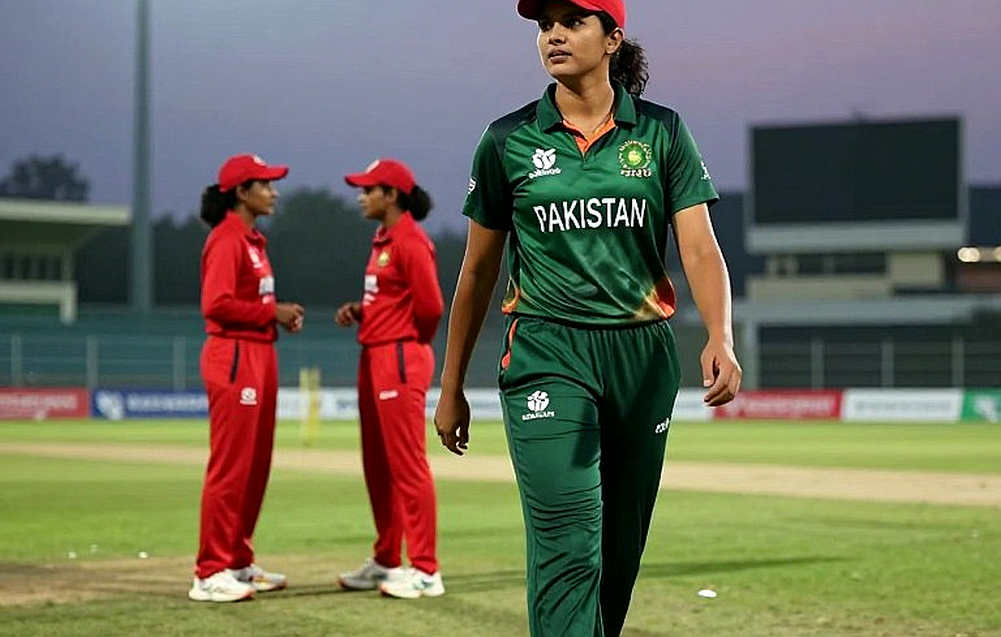
The process signal is here: ‘hopefully, he will deliver for us in many more games’ is a conditional expectation, not a selection guarantee. It implies the player is unproven at this level. The author’s ‘certain to come into contention’ is unqualified. The conditional sentence and the unqualified sentence do not carry equal evidential weight, and here the unqualified one is the weaker.
One small detail matters: describing Shaheen as ODI captain. Pakistan’s white-ball captaincy has churned repeatedly — Babar Azam, then Shaheen in T20Is, then Mohammad Rizwan, then Salman Ali Agha in 2026. The quotation’s window needs verification. If a report’s date has to be inferred from its own quotation, it is a puzzle rather than a news item.
The injury ledger nobody budgets for
Pakistan has a repeating pattern with young quicks: rapid rise, then a stress-injury interruption. Naseem Shah, Mohammad Hasnain, Ihsanullah — different names, same design. A young fast bowler’s ODI workload is a medium-term durability risk, not a solved problem.
In amortization terms, a young quick’s booked value is set by expected appearances, and that number must be divided by injury probability. A T20 World Cup in Asia in 2026 followed by a 2027 ODI World Cup means peaking twice in eighteen months. Load the same asset to its peak twice in eighteen months and it stops being an investment; it becomes debt. The report contains not a word on fitness, medical history or workload management.
The contrarian angle: elite for whom?
The ICC is simultaneously the event owner, the rights holder and the publisher. With those three roles in one building, the editorial incentive is simple: manufacture squad-selection narratives that make the tournament feel important early. The phrase ‘elite ODI group’ is a marketing classification, not a journalistic one.
A hard question follows. If the performance were genuinely landmark, why would overs, venue and opposition be missing? The innocent answer is that this is a feature, not a match report. The reader still deserves to know the difference, because a feature’s claims get quoted later as selection evidence.
There is a further layer. When I wrote about Barcelona’s €1.17bn debt, the point was that Barcelona’s €1.17bn debt is not a number; it is a transfer embargo with better PR. The same applies here. A spell is not a number; it is a selection argument with better PR. If the number existed, the argument could be audited. The number is absent, so the argument survives.
The most counterintuitive observation is this: Pakistan’s real crisis is not identifying talent. It is converting identified talent into fixed roles. Coaching and captaincy changes have moved the same players between number seven, number eight and the new-ball duties. Where role definition is unstable, ‘discovering an all-rounder’ repeats the problem rather than solving it. A new face is used to patch the old gap, never the system’s gap.
Takeaway: where the next domino falls
What to watch? First, how many overs Arafat bowls in his next ODI — a full ten-over quota or a four-over burst. That single number will reset the next six months of discussion. Second, his grade in the PCB’s next central-contract list. That is the real fee, not the headline. Third, where Multan Sultans bat him in the PSL — six or seven or eight. That tells you how much the franchise believes the all-rounder claim.
One date matters. A T20 World Cup in Asia in 2026, then South Africa, Zimbabwe and Namibia in 2027. Pakistan’s pace unit has to peak twice inside that window. In that budget the most valuable thing is not a new star; it is the decision about who gets rested.
The final question belongs to journalism. If the only verifiable description of a young player’s most important performance is ‘superb haul’, who benefits? Not the player. Not the board. The tournament does, and it is one year from the door. Do the arithmetic before the cricket starts.