
Finn Allen's ODI Return: How Solid Is the Middle-Order Conversion Project?
ফিন অ্যালেন ভারতের বিপক্ষে ওয়ানডে সিরিজের চতুর্থ ও পঞ্চম ম্যাচে নিউজিল্যান্ড দলে ফিরেছেন মিডল অর্ডার ব্যাটার হিসেবে। ২৭ বছর বয়সী এই ব্যাটারের ওয়ানডে রেকর্ড ২২ ম্যাচে ৫৮২ রান, Average ২৭.৭১, পাঁচটি অর্ধশতক ও শূন্য শতক। ২০২৩ সালের বাংলাদেশ সিরিজের পর তিনি কোনো ওয়ানডে খেলেননি। কেন উইলিয়ামসনের অবসরের পর সৃষ্ট শূন্যতা পূরণের কাঠামোগত প্রয়োজনে এই পরীক্ষা শুরু হলেও, তাঁর রূপান্তরের হার শূন্য শতাংশ এবং মিডল ওভারের চাহিদা ওপেনিংয়ের বিপরীত — তাই সীমিত নমুনায় সিদ্ধান্ত নেওয়া ঝুঁকিপূর্ণ।
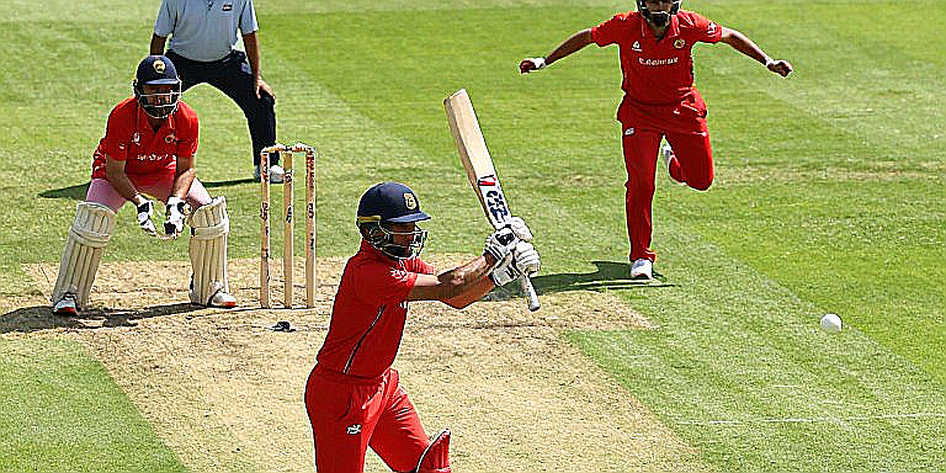
Finn Allen is back in New Zealand's ODI squad for the fourth and fifth matches of the ongoing series against India — but not in the role he is known for. The batter long identified as an explosive opener is being trialled in the middle order, and that trial sits at the centre of the Black Caps' planning for the 2027 ODI World Cup. The question worth asking is not whether Allen can bat at five, but whether the project behind that move rests on anything solid.
A necessary caveat first: this is squad news, not a match report. The underlying report carries no match-level data at all — no strike rate, no ball counts, no innings state. Any claim about how Allen actually batted in this series is unsupported. Everything below concerns selection logic and role conversion, not performance evidence.
The real context is Williamson's retirement
The driver here is structural, not form-based. Kane Williamson's retirement removed the lowest-variance anchor in the top order, and an anchor of that class cannot be replaced by reallocating roles. Moving Allen down the order does not fill the Williamson hole; it reshapes the order around it. The report frames the change as an exciting opportunity — the underlying cause is a vacancy crisis.
New Zealand's genuine selection question is not 'can Allen bat at five?' It is who bowls the middle overs and who anchors. A high-variance boundary hitter is being inserted into a lineup that has just lost its most stable batter — a variance-increasing move in a team that has just lost variance absorption capacity.
What Allen himself says
Allen describes the ODI problem in three parts: tempo, hitting along the ground, and rotating strike. Those are sound descriptions of the middle-overs challenge, where four fielders sit outside the circle and boundaries must be earned rather than taken. His stated plan is to target the fifth and sixth bowlers.
That framing is directionally correct but technically incomplete, because two structural rules are missing from the account. First, from over 41 only five fielders stay outside the circle, which makes the death phase a separate pressure entirely. Second, since 2026 two new balls are used from opposite ends, which leaves the middle-overs ball old and soft — precisely the condition that favours spin and frustrates a boundary-first method. Allen wants to attack in the least favourable environment for his own game. Without those rules in view, the plan to pressure the fifth bowler understates how hard middle-overs acceleration actually is.
What the numbers say
The only hard data available is Allen's ODI record: 582 runs in 22 matches at an average of 27.71, roughly 26.45 runs per innings, five fifties and no hundreds. Modern top-six regulars in the leading nations typically average somewhere between 35 and 42 — an approximate benchmark that still requires verification. By that standard, 27.71 sits below the bar.
The bigger issue is conversion. Five fifties in 22 innings with zero hundreds is a conversion rate of nothing at all, against a typical top-order rate of 25 to 35 percent. For a finisher that is the most damaging weakness available, because middle-order batters are judged precisely on turning starts into match-defining scores. The implication is that his problem is not getting in but going on.
A role mismatch
Allen's profile fits the opposite role to the one he is being trialled for. 'Explosive opener' describes a powerplay disruptor: two fielders out, a hard new ball, pace to work with. Overs 15 to 40 offer four fielders out, a soft ball, spin and angled fields. The demands are near-opposites. His own words concede that the required change is effectively a rebuild of method — lower-risk options, fours along the ground, hard running. That is skill acquisition, not a tactical tweak.
The largest trap here is mixing formats. His T20 reputation will be cited repeatedly as evidence of ODI readiness, which is a category error. T20 powerplay hitting and ODI middle-overs accumulation share almost no measurement overlap. Anyone using T20 strike rate to argue for ODI suitability at five should be treated as an unreliable analyst.
Age versus stale evidence
One unambiguous positive: he is 27, at the front edge of the 27-to-33 batting peak, exactly when method changes are most absorbable. That is a legitimate reason to run the experiment, and it also means a failure now would be more informative than a failure at 23 or 31.
The 27.71 average, however, is stale. He has not played an ODI since the Bangladesh series in 2026, and across that gap the number neither proves he cannot adapt nor supports the claim that he has matured. His testimony that more league and Auckland one-day cricket has improved his innings control is unverifiable self-report. The honest position is that the data is insufficient to forecast; only the trial will produce evidence.
The 2027 template question
The 2027 World Cup is scheduled in South Africa, Zimbabwe and Namibia, where seam, bounce and higher scoring dominate — not middle-overs spin strangulation. The selection rationale looks borrowed from a subcontinental-World-Cup template. This is a medium-confidence inference, since the report states nothing about venues.
The same limitation applies to the premise that New Zealand need middle-order strengthening. Without current data on New Zealand's middle-overs scoring rate and their scoring rate against spin, the gap cannot be sized. The report names a problem without measuring it.
A rare piece of expectation management
Allen's refusal of the succession narrative is strategically sound and uncommon. 'I don't have to try and replace Kane. It's pretty tough to live up to' is the correct posture, and it materially reduces the risk of a failed-heir narrative spiral.
The small-sample trap
Joining at match four of five means a likely maximum of two innings of evidence before selectors must judge him. Any conclusion drawn from that window is small-sample by construction. A one-year runway to the 2027 World Cup is adequate for a role conversion, but only if he gets sustained ODI volume. Two innings at the tail of one series is not that volume. If selectors treat them as the verdict, the experiment is being run at an invalid sample size.
In short: this recall is the product of structural need, not a reward for form. Allen's age is favourable, his expectation management is mature, and his understanding of middle-overs demands is accurate. But the only hard number available — 27.71 with zero hundreds — does not support the case for his new role, and that number is itself three years old. The project may succeed, but the evidence for it does not yet exist.