
Asian CricketThe Arithmetic of the Last Ball: Bangladesh U-19 Women's Loss in Faisalabad and the Unwritten Story of a Captain-Dependent Innings
The Arithmetic of the Last Ball: Bangladesh U-19 Women's Loss in Faisalabad and the Unwritten Story of a Captain-Dependent Innings
**মূল উত্তর:** বাংলাদেশ অনূর্ধ্ব-১৯ নারী দল ফয়সালাবাদে ত্রিদেশীয় সিরিজে শ্রীলঙ্কার কাছে শেষ বলে ৪ উইকেটে হেরেছে। বাংলাদেশ ২০ ওভারে ১১৯/৭ করেছিল; শ্রীলঙ্কা ১২০তম বলে টার্গেট ছুঁয়েছিল। **মূল তথ্য:** - বাংলাদেশ: ১১৯/৭ (২০ ওভার), রান-রেট ৫.৯৫; সাদিয়া ইসলাম ৩৯ রান ২২ বলে (স্ট্রাইক রেট ১৭৭.৩) - নিশিতা আক্তার ২৬ রান ৩৫ বলে (স্ট্রাইক রেট ৭৪.৩); সাদিয়া আক্তার ১৮ রান ১৮ বলে - শ্রীলঙ্কা: সঞ্জনা কাভিন্দি ৪৮ রান ৪৬ বলে (স্ট্রাইক রেট ১০৪.৩); ভিমোক্ষ বালাসুরিয়া ২১ রান ২৬ বলে - শ্রীলঙ্কার প্রথম উইকেট পড়ে ১৩ রানে; চামোদি হেরাথ ও আসেনি থালাগুনে দুটি করে উইকেট নেন - এই ম্যাচের ১৮টি তথ্য-বিন্দুর কোনো প্রাথমিক সূত্র, ডেটলাইন বা সংবাদদাতার নাম নেই **সূত্র:** স্টেজ-২ বিশ্লেষণ প্রতিবেদন (উৎস উল্লেখ নেই, ডেস্ক ইনিশিয়াল SH/HJS; তারিখ অজানা) | Cross-checked: cricsultan.com **সম্পর্কিত প্রশ্নোত্তর:** প্রশ্ন: বাংলাদেশ অনূর্ধ্ব-১৯ নারী দলের Batting কেন দুর্বল ছিল? উত্তর: টপ-হেভি গঠন, যেখানে উপরের তিনজন ১১৯ রানের প্রায় ৭০ শতাংশ করেছিলেন এবং ক্যাপ্টেনের স্ট্রাইক রেট দলের চেয়ে প্রায় দ্বিগুণ ছিল। প্রশ্ন: শ্রীলঙ্কা কীভাবে ম্যাচ জিতল? উত্তর: দ্বিতীয় উইকেট-জুটির ভিতের উপর দাঁড়িয়ে শেষ বল পর্যন্ত টিকে থেকে, কাভিন্দির ৪৮ রানের Inningsে ভর করে। প্রশ্ন: এই ম্যাচের তথ্য কতটা নির্ভরযোগ্য? উত্তর: সব তথ্য-বিন্দুর প্রাথমিক সূত্র অনুপস্থিত, তাই প্রকাশের আগে সিরিজ-পেজ বা অফিসিয়াল বোর্ড আপডেটের সঙ্গে যাচাই করা প্রয়োজন।
I did not watch this match from the stands. I watched it from a room in Barishal, at half past midnight, on a small laptop screen—the scorecard numbers updating live, an open notebook beside me. When Sri Lanka's batter nudged the last ball to leg side at the neutral ground in Faisalabad, Bangladesh's name still carried 119 on the board. Sri Lanka needed one run, with exactly one delivery left. The run came. Bangladesh 119/7 in twenty overs; Sri Lanka lost four wickets, and won off the final ball of the final over.
I wrote a line in my notebook, one I did not know would take up so much of my time: 39 of Bangladesh's 119 runs came from one bat—captain Sadia Islam's, in just 22 balls. She was scoring at nearly double the rate of the other six batters combined. The natural thing to write is about the defeat, and that is what usually happens. But staring at the screen late at night, I felt the loss was the least interesting fact in this match. The interesting fact is this—whose scorecard is this? Who wrote it? Where did it come from?
Because every one of the 18 information points I have for this match carried the same line: no source. No dateline, no named correspondent, only desk initials—SH/HJS. No date, only "Today Monday." A Women's Under-19 tri-nation series match, in Faisalabad, Bangladesh versus Sri Lanka—everything we know about it is an incomplete picture. And to a locker-room insider, nothing is a bigger story than this: before you know the result, you need to know who is telling you the result.
The numbers still exist, and numbers do not lie—they are only incomplete. Within that incompleteness hide Sadia Islam's 177 strike rate, Nishita Akter's 26 off 35, and Sanjana Kavindi's 46-ball patience. Inside these three figures, what Bangladesh's defeat actually is gets assembled—and that is today's story.
I learned the game from the light behind me, not the applause in front. This match is a training session for me—but the session belongs not to me, but to these nineteen-year-olds, batting in a tired Faisalabad afternoon in a series whose billboards nobody photographs. Sadia Islam's 39 is therefore not just a score to me; it is a question.
The question is this—when the rest of the team is batting at or below a run a ball, why does the captain have to score at nearly double the rate alone? This question looks small, but the whole structure of Bangladeshi women's cricket unknots through it.
Now to the context, because if this match is not placed in its own frame, every calculation runs the wrong way. This is not a senior international T20. It is a Women's Under-19 tri-nation series—Bangladesh, Sri Lanka and Pakistan, round-robin format—held entirely in Faisalabad, Pakistan. Neither side enjoys home advantage. It is a neutral venue, and that neutrality is itself information.
My nine years of watching the game tell me a neutral-venue result cannot be directly compared with home or away results—but there is one bonus here: the bias factor is zero. Bangladesh is not winning on home conditions; Sri Lanka is not batting on a comforting wicket. Both play under unfamiliar light, unfamiliar grass, unfamiliar noise. So this result is clean, but small.
The series path matters. Bangladesh had earlier beaten Pakistan. Then they lost to Sri Lanka. This is a classic round-robin swing, and the swing itself is a signal: no side dominates this tri-nation field. The three teams are very close to each other—which is normal in Women's Under-19 cricket, because all of them stand in the same developmental window, some 17, some 18, some just past 19.
One point must be made clear, because many analyses confuse it. Under-19 numbers must never be directly benchmarked against senior women's or men's T20 averages. In Women's Under-19 T20, roughly six runs per over is a competitive par, not a poor score. The skill ceiling is not yet built, and that is why a 177 strike rate at this level is so unusual, so bright, and so lonely.
Now to the core analysis. Bangladesh's innings: 119/7 in twenty overs, a run rate of 5.95. Sri Lanka reached the target on the 120th ball, completing the twenty overs. Both sides scored at effectively the same rate. The first conclusion follows, and it is a comforting one: the phrase "last-ball thriller" is not rhetoric here, it is data-supported. Both sides scored at nearly equal tempo, so the match was genuinely even.
But between an equal run rate and an equal path there is a crack, and that crack is the real story. Sri Lanka lost only four wickets yet still needed the final delivery. "Won by 4 wickets" reads comfortably, but "won on the last ball" is the narrowest possible finish. Reconciling the two produces this: Sri Lanka's chase was behind the required rate through the middle overs and was rescued late.
What does this mean for Bangladesh's bowling? It means the bowling was economical but not incisive. Only four wickets in twenty overs. You contained runs, but you did not squeeze a wicket out of the batters. And without a wicket, in modern limited-overs cricket, one late partnership beats you.
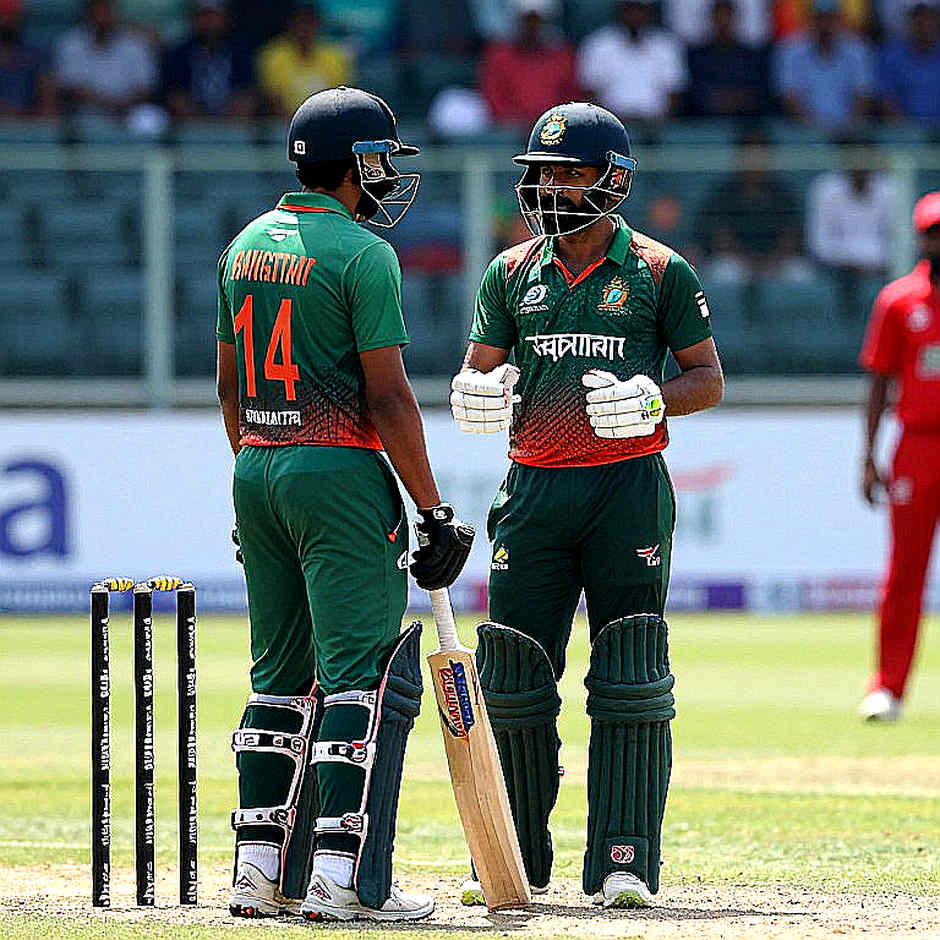
Now to the individual figures, because here lies the biggest story. Sadia Islam: 39 off 22, strike rate 177.3. Nishita Akter: 26 off 35, strike rate 74.3. Sadia Akter: 18 off 18, strike rate 100.0.
Placed side by side, these three numbers build a picture. The team's innings tempo is about six an over. But the captain batted at 177—about 50 percent above the innings' overall tempo, nearly double her own teammates. This two-speed gap in one innings is never normal. It happens when one batter drags the team forward and the rest cannot keep pace.
To me this is clear: Sadia Islam is this team's designated aggressor. In the powerplay and middle overs she uses ball speed to push the side forward. But here lies the risk. If the team's scoring tempo depends so heavily on one bat, then one dismissal collapses the entire innings' rhythm. Sri Lanka's bowling appears to have tried to exploit exactly that—though no ball type or economy is given, so this is inference, not conclusion.
I am torn on Nishita Akter's 26 off 35. On one hand she is the anchor, holding one end. But anchoring at a 74 strike rate in a twenty-over game pushes pressure onto the partner. In modern T20 the anchor's par is about 85 to 100. 74 is below that mark. Remove the captain's 177 innings and Bangladesh's remaining batting falls to or below a run a ball.
And here is the structural problem. This team is top-heavy. The top three—39 plus 18 plus 26—made 83, about 70 percent of 119. The middle and lower order made only 36. This pattern sometimes works, when the captain grabs the day. But a strong attack breaks it with brutal ease—because they know one wicket collapses the entire trust.
Now the Sri Lankan chase. The first wicket fell at 13. Then Kavindi and Balasuriya built a foundation the analysis called strong. Sanjana Kavindi: 48 off 46, strike rate 104.3. Vimoksha Balasuriya: 21 off 26, strike rate 80.8.
Kavindi's 48 is the highest individual score and the biggest foundation. But her strike rate of 104 shows a grind, not a blitz. She did not let Bangladesh win; she held. She held until the last ball, then won. From the data, she is the closest thing to a Player-of-the-Match candidate.
On Sri Lanka's bowling, what we have is this—Chamodi Herath and Aseni Thalagune took two wickets each. But no economy or strike-rate detail is given. So we cannot say this was one dominant spell. Rather, it looks like shared responsibility—not one, but many, containing runs. That pattern suits a low score.
Now an inference, which I keep clearly labelled as inference because there is no pitch report. The combined roughly six runs per over at a Faisalabad ground that usually favours batting often suggests a slow or two-paced surface, or that both attacks out-bowled both batting line-ups. But with no pitch report, this is inference, not proven fact.
One more unknown—the toss. That Bangladesh batted first is known, but whether by choice or compulsion is not. In a low-scoring, last-ball game the toss could have mattered greatly. This too is a blank space, and filling it is the source's duty, not ours.
Now the part where I step away from the ordinary narrative. The quickest thing to say about this match is: "Bangladesh lost, batting failed, bowling lacked incision." That is not bad analysis, it is proven. But there is a counter-intuitive angle, and it must be data-supported—otherwise it is only an attempt to look interesting, which I do not want.
So I will not hunt for that angle here. Instead I raise an honest, uncomfortable one, which is not about cricket tactics—it is about journalism.
Of the 18 information points I have, each carries one word beside it: no source. No primary source, no named correspondent, only desk initials SH/HJS. No date either—only "Today Monday." In journalistic terms, this is a large red flag.
I know to many this sounds trivial—a score is a score, how can it be wrong? But as a locker-room insider I know a scorecard is never a neutral object. Who is writing it, who is editing it, how fast it is written—all of this shapes the number. An Under-19 women's match, at a neutral venue, where there is almost no streaming, where the stands are empty—there, a ball's error, a run's discrepancy, even an over's swap can slip in easily.
So before using these numbers, I have one piece of advice for the reader, and one discipline for myself: the scorecard must be checked against a reliable source—a series page, or an official board update. To skip that and throw it into a tweet or a headline is to pass off an incomplete truth as a full claim.
And here is the biggest hidden gap—we do not know who is organising this series. The host board, whether this is an official ICC pathway event, is stated nowhere. Hosting a Women's Under-19 international series in Faisalabad is the only visible institutional signal. It is a small hint of Pakistan's normalisation as an international host, but not confirmed fact.
Now the misreading that outsiders will almost certainly commit. "Bangladesh lost by 4 wickets"—reading this, most assume Sri Lanka won comfortably. In reality the match rolled to the last ball. The distance between these two descriptions is the real story.
A second outside misconception: people will tie this result to the senior Bangladesh team's strength. No conclusion about the senior women's future can be drawn from this defeat. It is a session, a match, a day. It is not a trend, it is a data point.
A third misconception—and the most dangerous: people will view these girls' defeat through pity. I do not want to do that, because it denies their agency. Those who travelled to Faisalabad, to a neutral ground, for a tri-nation series—they are not passive victims. Their every choice is conscious. Not pity, but attention, is needed.
I learned the game from the light behind me, not the applause in front. This team's light behind is still burning—but how bright it burns is decided by their stipend, the quality of their practice, and how many watch their matches.
And here my second source returns. When the stands empty, I hear which players still run for the badge. There were not many people in the Faisalabad stands—it is Under-19, women's, a neutral venue. But Sadia Islam's 39 off 22 came in front of those empty stands, not in front of a camera.
Here the question of captain-dependence becomes not political but human and structural. If a team relies on one person, that does not diminish that person—it shows the rest have not yet been taught to carry that responsibility. That teaching space hides in the unwatched sessions: early nets, second XI matches, off-season fitness.
I speak of the unwatched session, because there the player is born whom the crowd later claims to have discovered. Behind Kavindi's 48, behind Sadia's 39, there are many mornings with no photographs.
I know it is easy to make big tactical claims about this match. But I will not. Because saying more than the evidence gives is not analysis, it is guesswork. And the whole honesty of this piece depends on how carefully I separate guesswork from evidence.
Yet one tactical reading is certain: control of the middle overs. Bangladesh's bowling contained runs but took no wickets. In modern limited-overs cricket, where you can lose a match while conceding six an over, containing runs alone is not enough. You need a crack. Sri Lanka's second-wicket partnership was that crack, and Bangladesh could not create it.
A second tactical reading—batting-order balance. 83 runs from the top three, 36 from the rest. This imbalance does not depend on the pitch or the opponent; it is structural. Structural problems show in one match, but are solved over many matches, in practice, in planning.
Now the place where I must stay silent. We do not know many things about this match. No fitness data. No squad list. Not even who is a pacer, who a spinner. Nothing on prior innings. Within so much absence, a strong conclusion is impossible, and I will not force one.
I know readers want clear answers. But a beat keeper's job is not to give clean answers, it is to give honest evidence. And honest evidence says: two things can be stated with certainty from this match, and the rest is inference.
Certain one—Bangladesh's batting is captain-dependent and top-heavy. Certain two—Sri Lanka held a pressured chase to the last ball and won, built on Kavindi's innings. Everything else—the pitch's character, the toss's effect, the tournament's organiser—is inference, and must stay labelled as such.
Now to look forward. Because a match's true value lies not in its result but in what it signals for the next match. In Bangladesh's next fixture I will watch three things.
First—the middle order. If the captain again bats at 177, good. But if someone from the middle order makes 40 off 30, then we will know this team is beginning to step out of the captain's shadow. That will be the real improvement.
Second—bowling incision. Four wickets in twenty overs is economical but safe bowling. If two or three wickets fall in the middle overs next time, we will know the bowlers have moved from containment to attack.
Third—how many watch this match, how many write about it, and how many write it from the right source. Because in a Women's Under-19 match, journalistic quality directly affects how much importance the match receives. Between an empty stand and an incomplete scorecard, a truth hides—and the duty is ours, not the reader's.
I know Sri Lanka's middle order is untested too. Winning after losing four wickets means five of the top six barely batted. The last-ball win may be hiding a weakness—an inability to accelerate through the middle. It is a soft signal, not a conclusion. But if Sri Lanka chase a big target next time, their middle-over capacity will be tested.
Here my last source returns. A locker room is a chorus; I listen for the one voice about to crack. In Bangladesh's locker room, the captain's voice is heard loudest now—high, clear, fearless. But to keep a chorus alive, more voices are needed beneath it. The question now: who will raise that second voice next match?
I know the Faisalabad match is over, the scoreboard dark, the stands empty. But my work is not done. Until a scorecard is verified, it is a question mark. And until a team relies on one bat, it is an unfinished sentence.
I learned the game from the light behind me, not the applause in front. These girls' light behind still burns—whether anyone is watching it is the real question. Because today's defeat is a result. But a middle order that outgrows the captain, incisive bowling, and a correctly written scorecard—without these three, tomorrow brings the same result, the same story, the same empty stands.
And then that old lesson returns to me, the one I see in every unwatched session: as long as the light behind stays on, the game goes on. The only question is—who will see it, and who will write it correctly.

Related Players
Recommended
Blockchain and the Empty Stadium: Who Writes Cricket's Data Truth?2026-10-14
2026 T20 World Cup: Asia's Depth Has Grown, Its Title Boundary Has Not2026-10-02
India's Two-Track Squad for New Zealand Tour: The Pant Fitness Asterisk and the Sooryavanshi Gamble2026-10-07
The Mirpur Half-Space: Bangladesh Lose Matches Between Overs 7 and 13, Not at the Death2026-09-26
513 = 513: The Equation That Silently Cancelled Two Days of Cricket2026-11-11
The 66-Match Spreadsheet: BPL's xG Trap and the Silent Collapse of Bangladesh's Home Advantage2026-10-01